
exhibitions |


Hirokazu artist talk
March 2009
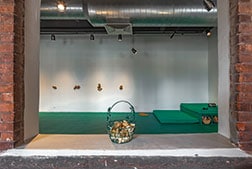
Installation photos of Hirokazu Fukawa’s Blizzard, a sculptural installation using 60 fluorescent bulbs to simulate a Siberian blizzard.
Hirokazu Fukawa photographed by John Groo
The Hirokazu Fukawa opening, February 2009

Hirokazu Fukawa
A Thought at the Edge of the Continent: Manchuria to Siberia 1942 - 1947

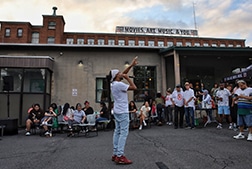
Hank Hoffman from Connecticut Art Scene, a blog dedicated to covering the Connecticut visual arts community, came to see Hirokazu's show last week. The artist was on hand to answer questions.

Excerpt from "Persistence (and deconstruction) of memory":
"There is no fully understanding the past. There is no reliving the past, especially not the past of someone else's jumbled memories. History is often a big story told through the prism of ideology. It is contested. What happened? What was it like to experience the occupation, the war, the imprisonment? Fukawa, in narration over the video installation, found that even in traveling to the locations where his father had fought and been detained, he could not feel his father's experience:

Instead I felt like a void standing in front of a void. Whenever I visited my father's past, whether physical traces remained or not, I felt that I myself was the void, that I was alienated from everything there--out of time and place, floating through lost memories that weren't my own.

These memories were no longer even his father's. Speaking with me in the main gallery at Real Art Ways, Fukawa tells me that when he asked his father where he had been disarmed by the Soviets, his father gave him a place name. Fukawa researched that location for a year before finding out through the official document that in fact his father had been disarmed at another location 150 miles away.

Most of the elements of A Thought at the Edge of the Continent can stand on their own. "Blizzard" is a stunning installation whether one is aware of its back story or not. Taken together, they constitute a moving meditation on political and personal history and the precious yet precarious nature of memory."

Read the full review (and leave comments) at Connecticut Art Scene.


Hirokazu Fukawa's father was a soldier in the Japanese army during World War II. He was a sniper. Near the end of the war, his commander replaced each soldier’s rifle with a land mine and ordered them to suicide bomb an enemy’s tank. No tank approached, and when the war ended, Fukawa’s father was sent to a POW camp in Siberia, where he spent most of his young manhood.

As a youth, Fukawa learned bits and pieces of his reticent father’s past, but not the whole story. Four years ago, Fukawa decided to find out more with the intention of using what he learned for a new art exhibition. He went on two research trips. The first trip was to Japan and Northeastern China, where his father spent his youth and fought during World War II. The second trip was to Siberia.

Fukawa’s original intention was to create a riddle for the viewer out of his father’s past, and to explore the connections his own father’s story had to those of modern suicide bomber attacks. The work evolved as Fukawa traveled to the places his father had once been. Instead of finding his father’s story, he found something else entirely.

A Thought at the Edge of the Continent, a sculptural installation with a companion video piece, is the culmination of Fukawa's four-year journey. The exhibition as a whole stays true to Fukawa’s original intention: to create a riddle for the viewer to solve. But the riddle’s answer has changed since Fukawa began his journey, and there may not be an answer at all.

This exhibition is made possible with support from the Edward C. & Ann T. Roberts Foundation's Creation of New Work Initiative.

roberts

Additional support for this exhibition comes from
The Artist's Resource Trust Fund Committee, Berkshire Taconic Community Foundation.