
Lean To / Gerald Abbott / Mark Bradford / Paul Chan / Isami Ching / Deborah Grant / Andrew Rogers / Lisa Sigal
A curatorial project from writer/curator Eungie Joo, Lean To gathered the works of seven artists of diverse influence and results. Lean To tackled race, history, politics and medium to connect concept with social potential.
Gerald Abbott creates embroidered canvasses neatly littered with symbols reminiscent of maps, family crests and company logos. He twists history to create an individual method of translation deconstructed by color and space. Mark Bradford paints luminous abstract canvasses influenced by the urban environment around him. Paul Chan's Happiness Finally After 35,000 Years of Civilization is an ambitions four-channel video installation of digital animation. Isami Ching's sculptures are a masquerade of ambiguity, humor and the accidental that will challenge and absorb the viewer. Deborah Grant draws from Basquiat, zine culture and creative, military and political history for severely dense, flat canvases. Andrew Roger's luscious photographs explore the built environment as natural landscape. In Cloud, Lisa Sigal's installation, she reacts to being evicted from her New York apartment, reassambling the walls, forcing them to function aside from thei roriginal physical and structural context.
Lean To featured new works by Sigal, Rogers, and Ching, and a new version of Paul Chan's Happiness Finally After 35,000 Years of Civilization.
Curator's Essay
Eungie Joo is a curator and writer based in New York. Recent projects include Widely Unknown at Deitch Projects (2001) and the 2002 MFA Thesis Exhibition at Columbia University. She is currently a visiting scholar at California Institute of the Arts in Valencia, California.
The lean-to is a shelter — man’s attempt at security in the face of an uncertain present. It is a straightforward attempt at structure, though makeshift, temporary, even haphazard. It is economical and functional. Often made of scavenged materials, the lean-to is interdependent with its surroundings. It is a proposition of stability.
Lean To takes its title from this protective structure to consider particular strategies of art practice and propose a way of thinking about the social relationships between individual works. The exhibition includes the work of seven artists who posit various systems of collection, organization, and order to address excessive resources, untangle logic, and fuse meaning with gesture.
Gerald Abbott’s embroidered canvases are neatly littered fields of detached and seemingly indecipherable symbols that are reminiscent of map icons, family crests, and company logos, now void of their historical and cultural referents. In these works, separation by color and space rejects any potential co-dependency between individual images. What remains is a visual field where ground and object, representation and its abstraction strive for equivalence. Distilling the places, objects, and images that comprise his contemporary world into hand-stitched line drawings, Abbott creates his own method of translation, an entire world of relevant meanings, now recodified and refigured in a newly democratic field of interaction.
Mark Bradford’s luminous abstract canvases offer both an eerie translucency and an unrelenting physicality. Responding to history and the structures of gender, culture, and stereotypes it prescribes, Bradford employs a strategy of minimalism that depends on a logic of limitations. His color choices are inspired by the colored copier paper available at Office Depot on a given day. Burnt edges of hairdressers’ permanent wave papers serve as line. These restrictions mimic a tension that is present in Bradford’s everyday world. For Bradford, “there is an abstraction that happens in the city that interests me; a dislocation of reality when you have the Mexican taqueria next to the Black wig shop across the street from the Korean nail shop. I translate this suspension and interruption into my own palette.”
Paul Chan explores utopic desire, and forms of communication and exchange. He creates animated characters, computer fonts, and substitute narratives that are in and of themselves systems of knowledge. Lean To features the artist’s most ambitious work to date, a three-channel video installation of the digital animation, Happiness (Finally) After 35,000 Years of Civilization. Imagining the utopian philosopher Charles Fourier as his physicist, and artist Henry Darger as his casting director, Chan employs computer animation to explore the societal regulation of desire. To tell his epic tale, Chan has created a visual library of little girl armies, enticing flowers, injured “suits,” and repetitive actions. The resulting work dares to imagine what the combined visions of Fourier and Darger might have looked like had they been exposed to Penthouse magazine, the internet, Japanese pornography, and the work of Arbus, Belmer, Bernini, and Muybridge.
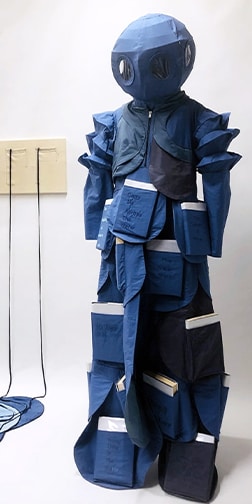
Isami Ching is interested in concepts of ambiguity, masquerade, humor, and the accidental. His work addresses notions of order, the confluence of forces behind a sculptural gesture, and the relationship between the viewer and the charged space around a sculptural object. While his investigations accept viewers’ employment of prejudice, assumption, and simplification as a kind of defensive system of order in the face of infinite possibilities, Ching’s work strives for a purer, more immediate state of interaction. In Conflate (2002), Ching attempts to enclose or occupy as much space as possible with as little as possible. Sewn nylon fabric is inflated by air circulated by simple electric fans. Though the sculpture projects a solid but flexible surface, the bulk of this monumental object is, in fact, air. By defining a structure for the containment of the invisible or speculative, Ching offers unusual approaches to perception and interaction. For Lean To, Ching has created a new architectural intervention in the main gallery that further explores these ideas of space, force, and the visible.
According to Deborah Grant, “Memories of private school dorms, psych wards, crack and smack dwellings, dead end bars in the afternoon, and the people that I met in these places, are the catalysts for my paintings and drawings.” Text, symbol, and image spill over every inch of Grant’s dense, flat canvases. Tapping an endless well of seemingly unrelated genealogies and logics, Grant extends the tradition of political cartooning. She is an avid and thorough researcher, deeply influenced by Jean Michel Basquiat, the creative, military, and political history of the United States, and the communicative efficacy of zine culture. Grant has developed curious, non-linear visual narratives that accept the bleak world of conspiracy and subterfuge as the quotidian. She is effortless and convincing, confident of her viewer’s resourcefulness, faith, and flexibility. Grant’s works in this exhibition are part of an ongoing series called Random Select. According to the artist, ”Random refers to any subject matter that is part of a social, political, religious, and humorous imaginary. Select refers to the actual choice of subject matter and how it is depicted. I take these random ideas and employ them as metaphors for the human condition. This is my key to Pandora’s box.”
Combining the detached, objective language of documentary photography with a rich, painterly palette, Andrew Rogers’ works often explore the built environment as natural landscape. Focusing on spaces in transition, Rogers strives for a concrete and physical relationship between viewer and image; he is interested in the viewer’s relationship to the landscapes pictured, as well as in the relationship to an uncontainable present. In his work Simultaneous Events (2001-2), Rogers considers the coincidence of extreme action and seemingly inert space. The work is a grid of twenty-eight color photographs of relatively innocuous and benign places related to entertainment and leisure. On the bottom of each image is a white margin on which a date is printed. The dates correspond to “newsworthy” events that have occurred in the United States over the past five years. One date coincides with the beating death of Matthew Shepherd in Wyoming, another to the day Roy Byrd, Jr. was dragged to death behind a truck by two men in Texas. The dates are not meant to dictate content to the viewer. Instead, Rogers hopes “to raise a question about the perception of these events and to generate conversation around a kind of collective amnesia in America for events that are incredibly significant in terms of their potential impact on our society but that are trivialized through the filters of the media.”
Lisa Sigal’s works on canvas, walls, and recycled sheet rock explore artifice and the possibility of physical entry to the picture plane, and offer a momentary bridge between the unequal worlds of the imaginary and the real. Sigal has long been interested in systems of transformation through visual perception and the narratives that abstraction can communicate. With an intensely saturated palette borrowing from dream analysis, color theories, Indian miniature painting, and the lived world, Sigal wields a charged, incessantly intriguing form of abstraction.
Like many other artists in New York, Sigal recently lost the lease on her studio space, where she has worked for the past eighteen years. The forced transition of relocation has intensified Sigal’s concern with the idea of the disappearance of walls — how pictures hung on walls make the walls disappear. But what happens when you remove the structure of the wall? When the wall becomes a picture, or part of the illusion that has formerly been the terrain of pictures? In Cloud (2003), Sigal worked on and dismantled the walls of her studio, all the while grappling with recycled imagery from the past, the collapsing architecture of her neighborhood, and ideas of her body in relation to a location. Reassembled at Real Art Ways, the walls are now forced to function aside from their original physical and structural context, thereby rendering them pictures, illusion.
Eungie Joo
Los Angeles, 2003