Hirokazu Fukawa
A Thought At the Edge of the Continent: Manchuria to Siberia 1942 - 1947

Opening Reception: Saturday, February 7, 4 PM
Artist Talk: Thursday, March 5, 6 PM
closes Sunday, March 22, 2009

Hartford, Connecticut – Real Art Ways presents A Thought at the Edge of the Continent: Manchuria to Siberia 1942 - 1947 by Hirokazu Fukawa. The sculptural exhibition tells the story of Fukawa’s father, trained to be a suicide bomber for Japan
in World War II, and explores themes of personal epiphany and the riddle of memory. A Thought at the Edge of the Continent opens on Saturday, February 7, 2009 with a reception at 4 PM. Admission to the opening is free of charge. After the opening, admission is a $3 suggested donation, and free for members and cinema patrons. Real Art Ways is located at 56 Arbor Street in Hartford’s Parkville
neighborhood. For more information, call 860.232.1006 or visit realartways.org

Fukawa’s work focuses on his journey deep into the story of his father. Fukawa’s father was a soldier in the Japanese army during World War II. He was a sniper. Near the end of the war, his commander replaced each soldier’s rifle with a land mine and ordered them to suicide bomb an enemy’s tank. No tank approached, and when the war ended, Fukawa’s father was sent to a POW camp in Siberia, where he spent most of his young manhood.

As a youth, Fukawa learned bits and pieces of his reticent father’s past, but not the whole story. Four years ago, Fukawa decided to find out more with the intention of using what he learned for a new art exhibition. He went on two research trips. The first trip was to Japan and Northeastern China, where his father spent his youth and fought during World War II. The second trip was to Siberia. Fukawa’s original intention was to create a riddle for the viewer out of his father’s past, and to explore the connections his own father’s story had to those of modern suicide bomber attacks.

The work evolved as Fukawa traveled to the places his father had once been. Instead of finding his father’s story, he found something else entirely:

I felt like a void standing in front of a void. Wherever I visited my father’s past, whether physical traces remained or not, I felt that I myself was the void, that I was alienated from everything there, out of time and place, floating through lost memories that weren’t my own… probably it’s because I was trying to relive someone else’s past. I was trying to relive my father’s past. (Excerpt from Hirokazu Fukawa’s Manchuria to Siberia 19421947, video 2008 )

The four-year project started with a website, www.fukawa.org. Fukawa also created a series of collages using digital prints of 12th century Japanese scrolls and exhibited work in two large installations in 2006 and 2007. The culmination of his project is
the sculptural installation at Real Art Ways. The sculptures in Fukawa’s Real Art Ways exhibit will be accompanied by a video
narrative of Fukawa’s journey into his father’s past. The sculptures were informed by his research, and tell both the story of his father and the other stories Fukawa found in his journey – those of his father’s fellow prisoners, those of Manchuria and its people, and the story of how stories are created.

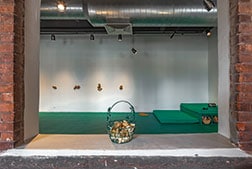
Blizzard, an installation of 60 fluorescent bulbs, will recreate the blizzard his father lived through in Siberia.

Gaki Zousi will use scrolls reminiscent of those of 12th century Japan. On the scrolls will be examinations of the wild Siberian plants his father and other prisoners in the POW camp ate to fight away the hell of starvation.

The Third International is a staircase adorned with 20 string and tin can telephones broadcasting a mix of music.

The exhibition as a whole will stay true to Fukawa’s original intention: to create a riddle for the viewer to solve. But the riddle’s answer has changed since Fukawa began his journey, and there may not be an answer at all.

Will K. Wilkins, Executive Director of Real Art Ways comments on Fukawa’s progress since the inception of the project:

“Hiro’s journey begins as personal, and in some ways political, and transcends the particulars to come to grips with what is ultimately unknowable.”

About the Artist

Hirokazu Fukawa is an associate professor at University of Hartford in West Hartford, Connecticut. He has shown work at The Trakt Project Raum in Berlin, Germany; Gallery Coco in Kyoto, Japan; and the ARC Gallery in Chicago, Illinois.

Installation photo: Blizzard
hirokazu


This exhibition is made possible with support from the Edward C. & Ann T. Roberts Foundation's Creation of New Work Initiative.

Additional support for this exhibition comes from
The Artist's Resource Trust Fund, Berkshire Taconic Community Foundation.

Real Art Ways is supported by Real Art Ways Members,
The National Endowment for the Arts, The Warhol Foundation,
The Wallace Foundation, The Greater Hartford Arts Council,
The Connecticut Commission on Culture and Tourism, and
The Hartford Foundation for Public Giving.


                       #                  #                         #

Press Contact:
Abigail Ohlheiser

860 232 1006 x114
aohlheiser@realartways.org

Real Art Ways
56 Arbor Street
Hartford CT 06106
860 232 1006
realartways.org

info@realartways.org

Gallery Hours:
Tuesday through Thursday and Sunday, 2-10 pm;
Friday and Saturday 2pm-midnight. Closed Mondays.


Cinema open daily.

ABOUT REAL ART WAYS

Real Art Ways is one of the leading contemporary arts organizations in the United States, with a record of linking artists, innovation and community. Programs include visual arts, with exhibitions, public art projects, and artist presentations; cinema, with independent and international films 7 nights a week; music; performance; spoken word; community and educational programming.

top